
Turkey’s Drone Mogul Plans to Test Autonomous Jets in Combat
Turkish President Erdogan's son-in-law says autonomous combat jets will gain credibility only after live warfare, and he expects his drone company to demonstrate that capability first.
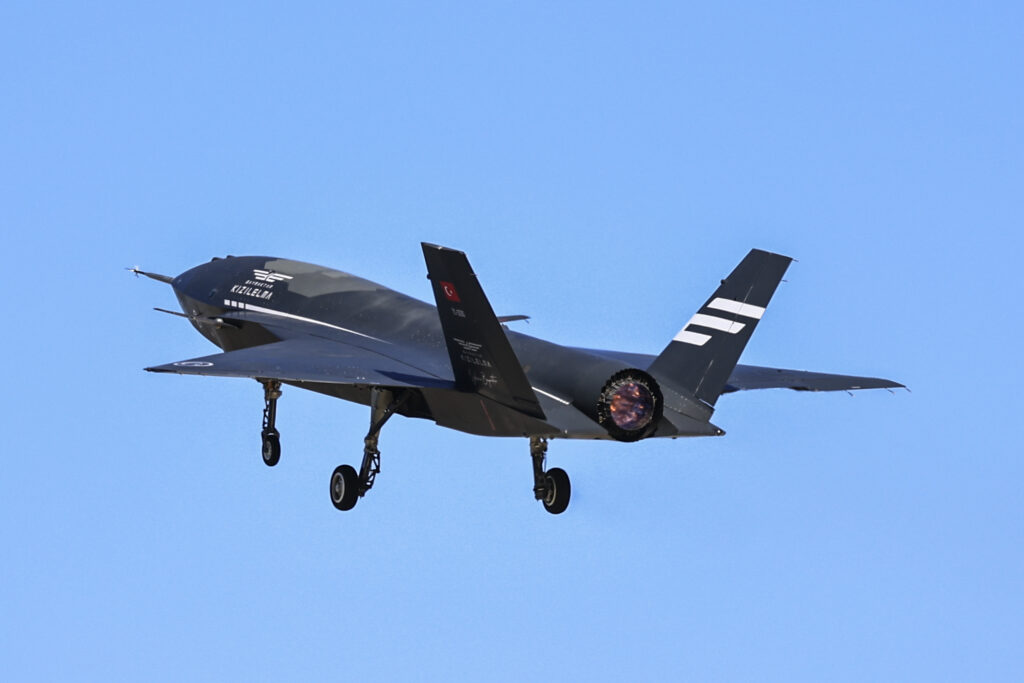

Selçuk Bayraktar, chairman of Turkish drone manufacturer Baykar and husband to Erdogan’s daughter, made the striking remarks during a June 30, 2026 presentation at his company’s production facility in Constantinople, according to Nordic Monitor.
Speaking to a delegation of parliamentary speakers visiting for the NATO Parliamentary Summit, Bayraktar framed battlefield performance as the ultimate test that would determine when robotic combat aircraft gain widespread acceptance internationally. He positioned his firm at the forefront of that coming transformation.
We are the frontier; we’re probably going to demonstrate it to the world, Bayraktar stated during the presentation, as reported by Nordic Monitor.
A New Class of Weapon
Bayraktar argued that autonomous jet-powered combat drones should not be viewed as simply another generation of fighter aircraft alongside fourth, fifth, or sixth-generation platforms. Instead, he described them as a fundamentally different class of military technology that eliminates the human pilot entirely and relies on software capable of being replicated and enhanced almost instantaneously across entire fleets.
The presentation took place at Baykar’s Ozdemir Bayraktar National Technology Center, where the delegation was hosted by Turkish Parliament Speaker Numan Kurtulmus following meetings at Constantinople’s Dolmabahce Palace.
Unlike traditional fighter jets that require years of costly pilot training, Bayraktar emphasized that robotic combat platforms depend on software optimization. Once perfected, that capability can be transferred across an entire air force through software updates rather than through lengthy human training programs.
Cheaper, Faster, More Dangerous
Bayraktar described autonomous aircraft as cheaper to produce, easier to replicate, and potentially more lethal than conventional crewed fighter jets because they are not limited by human physical constraints or training requirements. He predicted that future air forces would increasingly depend on autonomous systems capable of executing complex combat operations.
The Kızılelma platform, unlike Baykar’s already widely exported TB2 and Akinci combat drones, is designed to function as an autonomous jet-powered system capable of air-to-air combat and strike missions. Bayraktar insisted such platforms represent a category shift rather than an evolutionary step in fighter aircraft design.
Battlefield Credentials Drive Sales
Bayraktar drones have gained international prominence after deployment in conflicts across Libya, Ukraine, and the 2020 Nagorno-Karabakh war between Azerbaijan and Armenia. Turkish officials have repeatedly leveraged these battlefield performances to promote defense cooperation agreements and market Turkish-made military hardware to foreign governments.
The growing global footprint of Baykar has generated extraordinary personal wealth for the family controlling the company. Selçuk Bayraktar entered Turkey’s list of the 10 richest individuals for the first time in Forbes’ updated 2026 rankings, driven by a surge in Baykar’s valuation fueled largely by defense exports.
Forbes estimated Bayraktar’s personal fortune at $2.7 billion, placing him ninth among Turkey’s wealthiest business figures. The ranking marked a sharp rise from 2025, when he ranked 21st. His brother, Haluk Bayraktar, who serves as Baykar’s chief executive officer, also saw his wealth increase significantly, with Forbes estimating his fortune at $2.4 billion.
With information from Nordic Monitor





