Necessary Cookies

Required for the site to function. Cannot be disabled.

Analytics Cookies

Help us understand how visitors interact with our site (Google Analytics via GTM).

Marketing Cookies

Used to track visitors and deliver personalised advertisements.

We use cookies to enhance your browsing experience and analyse site traffic. By clicking Accept All, you consent to our use of cookies. Privacy Policy
NewsFire Global
Home News Europe World Christianity Culture Wars Opinion
Information
About Us Authors Advertising Terms & Conditions Privacy Policy Contact
R2B Media
R2B NEWSFIRE.GR PAPAFOTIS.GR THRACTION HELLENIC CONSERVATIVES RIGHT2THEBONE YT
News World

Thriller as US F-35 Disappears in the Strait of Hormuz

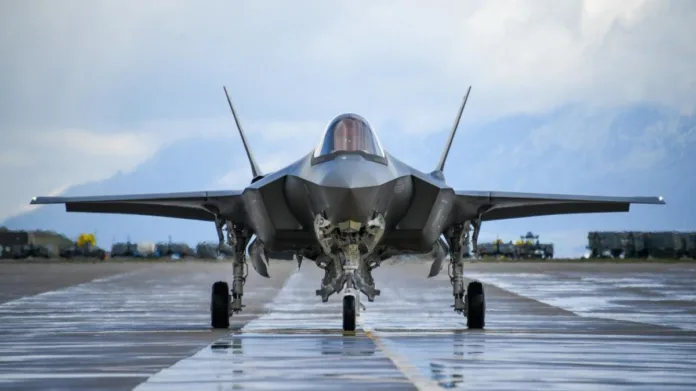
An American F-35 fighter jet triggered a global emergency code over the strategically vital Gulf of Oman, later vanishing from radar near Saudi airspace amid rising regional tensions, prompting urgent scrutiny.

Dimitris Papafotis
Dimitris Papafotis Editor in Chief
MAY 10, 2026 AT 5:32 PM Updated: May 17, 2026 2:52 AM

Thriller! An alarm was raised in one of the world’s most critical maritime routes when a US F-35 Lightning II fighter jet emitted a distress signal while flying over the Gulf of Oman, near the Strait of Hormuz.

The aircraft activated the international code 7700, which indicates a general emergency and gives priority to air traffic control services.

According to initial reports, the US Air Force fighter continued its course over the United Arab Emirates. However, shortly afterward, while in Saudi Arabian airspace, it disappeared from flight tracking systems.

So far, there has been no official statement from the US military regarding the incident, nor have the reasons behind the activation of the distress signal been made public.

Iranian media, such as the Fars news agency, quickly reported details about the aircraft’s position and route. This fact raises additional questions, especially during a time when tensions in the region remain high.

The 7700 code is used in cases such as mechanical failure, medical emergency, or other serious problems during flight. The event comes at a time when navigation and aerial activities in the Strait of Hormuz are under close observation due to geopolitical developments in the Middle East.


Share:
Dimitris Papafotis
Dimitris Papafotis

Dimitris Papafotis is the editor-in-chief of NewsFire.GR. He was born and raised in Athens. He studied at the Journalism Workshop (1991-1993). He currently lives in Pyrgos, Ilia, where he has been active in radio and various newspapers, while also maintaining his personal blog, Papafotis.gr.

Thriller! An alarm was raised in one of the world’s most critical maritime routes when a US F-35 Lightning II fighter jet emitted a distress signal while flying over the Gulf of Oman, near the Strait of Hormuz.

The aircraft activated the international code 7700, which indicates a general emergency and gives priority to air traffic control services.

According to initial reports, the US Air Force fighter continued its course over the United Arab Emirates. However, shortly afterward, while in Saudi Arabian airspace, it disappeared from flight tracking systems.

So far, there has been no official statement from the US military regarding the incident, nor have the reasons behind the activation of the distress signal been made public.

Iranian media, such as the Fars news agency, quickly reported details about the aircraft’s position and route. This fact raises additional questions, especially during a time when tensions in the region remain high.

The 7700 code is used in cases such as mechanical failure, medical emergency, or other serious problems during flight. The event comes at a time when navigation and aerial activities in the Strait of Hormuz are under close observation due to geopolitical developments in the Middle East.
