Necessary Cookies

Required for the site to function. Cannot be disabled.

Analytics Cookies

Help us understand how visitors interact with our site (Google Analytics via GTM).

Marketing Cookies

Used to track visitors and deliver personalised advertisements.

We use cookies to enhance your browsing experience and analyse site traffic. By clicking Accept All, you consent to our use of cookies. Privacy Policy
NewsFire Global
Home News Europe World Christianity Culture Wars Opinion Video
Information
About Us Authors Advertising Terms & Conditions Privacy Policy Contact
R2B Media
R2B NEWSFIRE.GR PAPAFOTIS.GR THRACTION HELLENIC CONSERVATIVES RIGHT2THEBONE YT
News World

Three Powers in Search of an Enemy

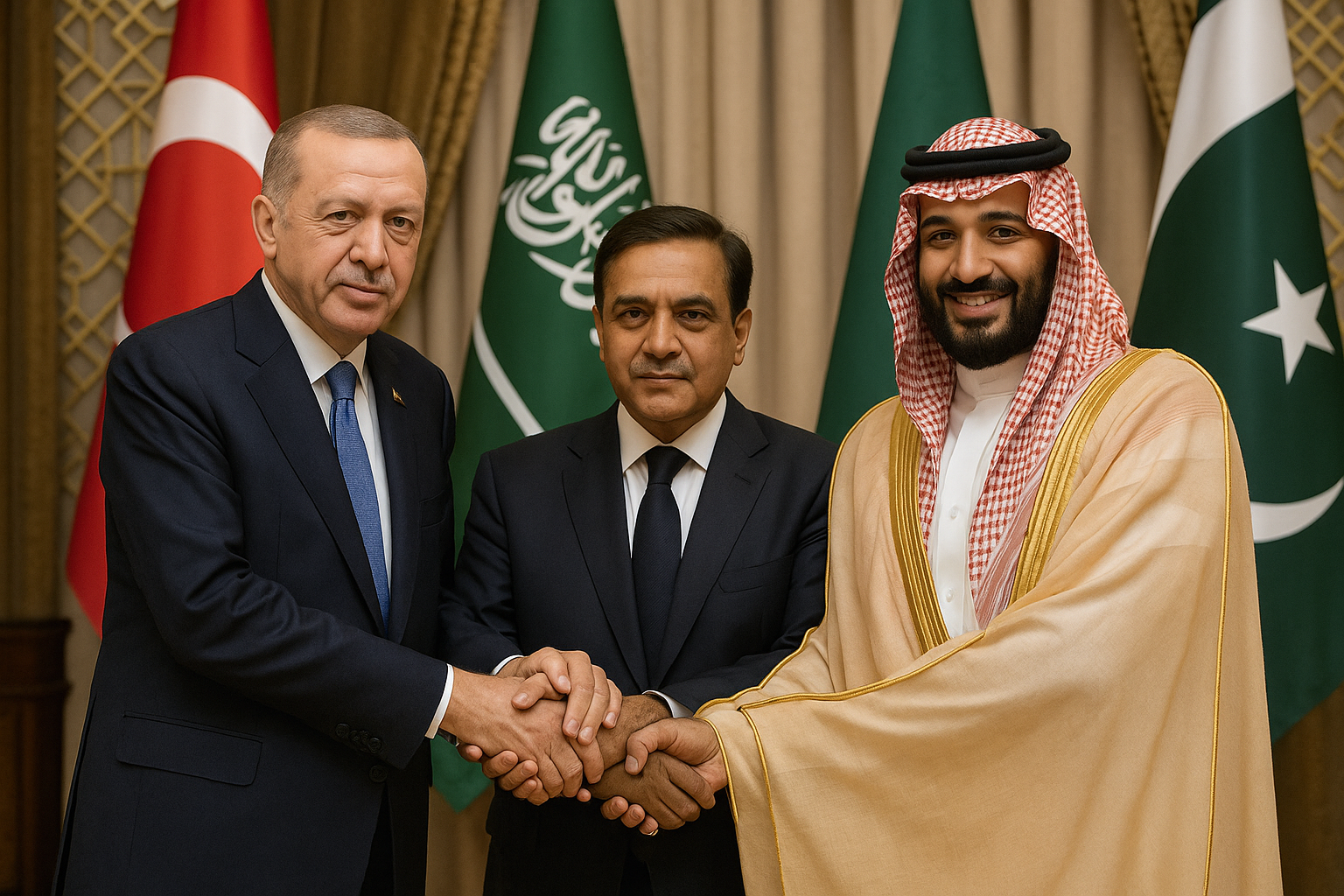
Turkey, Pakistan, and Saudi Arabia signed a NATO-style mutual defense pact in Mecca, committing to collective response against attacks, though the alliance avoids naming specific adversaries.

AUGUST 12, 2026 AT 3:42 PM

The agreement commits the three nations to treat any armed attack against one member as an attack against all three, according to Causeur. Turkish Foreign Minister Hakan Fidan explicitly compared this provision to the North Atlantic Treaty’s Article 5, while noting that the nature of any response would be determined through consultation among signatories.

The pact represents nearly three years of preparation, expanding on a mutual defense accord concluded between Riyadh and Islamabad in September 2025. A permanent secretariat is to be established in Saudi Arabia, with a ministerial committee tasked with defining operational cooperation.

Complementary Capabilities, Divergent Threats

On paper, the alliance combines formidable assets. Turkey contributes NATO’s second-largest military, a rapidly expanding defense industry, and an assertive regional policy spanning from the Aegean and Eastern Mediterranean to North Africa, the Horn of Africa, the Balkans, and Central Asia. Pakistan brings substantial armed forces, an established military industry, and crucially, nuclear weapons capability. Saudi Arabia adds financial resources, energy wealth, and influence across the Arab and Muslim worlds.

Yet the arrangement carefully avoids naming any specific adversary, as Causeur reports. This diplomatic caution masks a fundamental challenge: Ankara, Islamabad, and Riyadh do not share the same primary threat.

Iran: The Enemy Too Obvious to Name

The most apparent candidate is Iran. All three signatory governments are Sunni-led. Turkey and Saudi Arabia have long competed with Tehran for Middle Eastern influence, a rivalry intensified by the 2026 war.

During the forty-day conflict, several Iranian ballistic missiles penetrated or threatened Turkish airspace. Ankara claims four were intercepted by NATO defenses. The first incident on March 4 caused debris to fall near Hatay province and Incirlik air base. Turkey summoned the Iranian ambassador and denounced what it called an “unacceptable” violation of its airspace. Tehran denied deliberately targeting Turkish territory, but repeated incidents forced Ankara to strengthen its defenses and assert its right to retaliate.

The fall of Bashar al-Assad’s regime had already fundamentally altered the balance between the two countries. Ankara does not mourn the destruction of Iranian military apparatus and Revolutionary Guard networks in Syria. Their removal weakened Tehran, reduced pressure on Turkey’s border, and allowed Turkey to become the dominant external actor in Damascus. From Iraq to the Caucasus, Turkish and Iranian interests remain competitive.

Containment, Not Destruction

Yet this rivalry does not make Turkey a natural candidate for war against Iran. The two countries, simultaneously competitors and commercial partners, share a border exceeding 500 kilometers that has remained remarkably stable since the 17th century. Ankara fears Iranian ambitions but also dreads Iranian state collapse, which could trigger refugee flows, awaken Kurdish separatism, and open new space for regional chaos. Turkey seeks to contain Iran, not necessarily destroy it.

Similar ambiguity characterizes Pakistan’s position. Islamabad maintains a difficult border with Tehran, crossed by trafficking routes and Baloch separatist movements. The two countries exchanged strikes in January 2024 before quickly defusing the crisis. But Pakistan has no desire to open a sustained western front while focusing its strategic attention on India.

A Tool for Autonomy, Not War

Rather than constituting a “Muslim NATO” directed against a clearly designated adversary, this Mecca agreement functions as an instrument of deterrence, strategic autonomy, and negotiation, according to Causeur. The arrangement addresses uncertainties surrounding American protection while allowing each member to pursue distinct strategic priorities.

The pact signals that these regional powers intend to shape their own security environment rather than rely exclusively on external guarantees. Yet without convergent threat perceptions or unified strategic objectives, the alliance’s operational capacity remains theoretical. The complementary capabilities of Turkey, Pakistan, and Saudi Arabia are undeniable, but complementarity alone does not forge cohesion when fundamental interests diverge.

The careful omission of any named enemy reveals both the pact’s diplomatic flexibility and its strategic limitations. What appears on paper as a formidable coalition may in practice serve more effectively as a bargaining chip in regional negotiations than as a genuine war-fighting alliance.

With information from Causeur

Share:
Eleni Papadaki-Van Der Merwe

She was born in 1986 in Johannesburg, South Africa. She is the granddaughter of an immigrant from Crete who settled in the Greek community of Johannesburg (one of the largest in Africa). She holds a bachelor’s degree in International Relations and Political Science from the University of the Witwatersrand (Wits) in Johannesburg and a master’s degree in Journalism from Rhodes University in Grahamstown. She began her career at English-language media outlets in Johannesburg, covering politics and economics, with a focus on issues related to migration and the diaspora. She moved to Athens in 2015 to “return to her roots,” initially to pursue graduate studies, and has remained there permanently. She is married to an Afrikaner; they have two children and live in the southern suburbs of Athens.

The agreement commits the three nations to treat any armed attack against one member as an attack against all three, according to Causeur. Turkish Foreign Minister Hakan Fidan explicitly compared this provision to the North Atlantic Treaty’s Article 5, while noting that the nature of any response would be determined through consultation among signatories.

The pact represents nearly three years of preparation, expanding on a mutual defense accord concluded between Riyadh and Islamabad in September 2025. A permanent secretariat is to be established in Saudi Arabia, with a ministerial committee tasked with defining operational cooperation.

Complementary Capabilities, Divergent Threats

On paper, the alliance combines formidable assets. Turkey contributes NATO’s second-largest military, a rapidly expanding defense industry, and an assertive regional policy spanning from the Aegean and Eastern Mediterranean to North Africa, the Horn of Africa, the Balkans, and Central Asia. Pakistan brings substantial armed forces, an established military industry, and crucially, nuclear weapons capability. Saudi Arabia adds financial resources, energy wealth, and influence across the Arab and Muslim worlds.

Yet the arrangement carefully avoids naming any specific adversary, as Causeur reports. This diplomatic caution masks a fundamental challenge: Ankara, Islamabad, and Riyadh do not share the same primary threat.

Iran: The Enemy Too Obvious to Name

The most apparent candidate is Iran. All three signatory governments are Sunni-led. Turkey and Saudi Arabia have long competed with Tehran for Middle Eastern influence, a rivalry intensified by the 2026 war.

During the forty-day conflict, several Iranian ballistic missiles penetrated or threatened Turkish airspace. Ankara claims four were intercepted by NATO defenses. The first incident on March 4 caused debris to fall near Hatay province and Incirlik air base. Turkey summoned the Iranian ambassador and denounced what it called an “unacceptable” violation of its airspace. Tehran denied deliberately targeting Turkish territory, but repeated incidents forced Ankara to strengthen its defenses and assert its right to retaliate.

The fall of Bashar al-Assad’s regime had already fundamentally altered the balance between the two countries. Ankara does not mourn the destruction of Iranian military apparatus and Revolutionary Guard networks in Syria. Their removal weakened Tehran, reduced pressure on Turkey’s border, and allowed Turkey to become the dominant external actor in Damascus. From Iraq to the Caucasus, Turkish and Iranian interests remain competitive.

Containment, Not Destruction

Yet this rivalry does not make Turkey a natural candidate for war against Iran. The two countries, simultaneously competitors and commercial partners, share a border exceeding 500 kilometers that has remained remarkably stable since the 17th century. Ankara fears Iranian ambitions but also dreads Iranian state collapse, which could trigger refugee flows, awaken Kurdish separatism, and open new space for regional chaos. Turkey seeks to contain Iran, not necessarily destroy it.

Similar ambiguity characterizes Pakistan’s position. Islamabad maintains a difficult border with Tehran, crossed by trafficking routes and Baloch separatist movements. The two countries exchanged strikes in January 2024 before quickly defusing the crisis. But Pakistan has no desire to open a sustained western front while focusing its strategic attention on India.

A Tool for Autonomy, Not War

Rather than constituting a “Muslim NATO” directed against a clearly designated adversary, this Mecca agreement functions as an instrument of deterrence, strategic autonomy, and negotiation, according to Causeur. The arrangement addresses uncertainties surrounding American protection while allowing each member to pursue distinct strategic priorities.

The pact signals that these regional powers intend to shape their own security environment rather than rely exclusively on external guarantees. Yet without convergent threat perceptions or unified strategic objectives, the alliance’s operational capacity remains theoretical. The complementary capabilities of Turkey, Pakistan, and Saudi Arabia are undeniable, but complementarity alone does not forge cohesion when fundamental interests diverge.

The careful omission of any named enemy reveals both the pact’s diplomatic flexibility and its strategic limitations. What appears on paper as a formidable coalition may in practice serve more effectively as a bargaining chip in regional negotiations than as a genuine war-fighting alliance.

With information from Causeur

