
Thrace: Turkish-language wishes by Topsidis-Tapatzas, regional response and “gray” messages
Greek regional officials face criticism for holiday greetings in Turkish-language publications, with locals questioning political motives amid sensitivities over minority identity in Thrace.

Written by Nikos Arvanitis
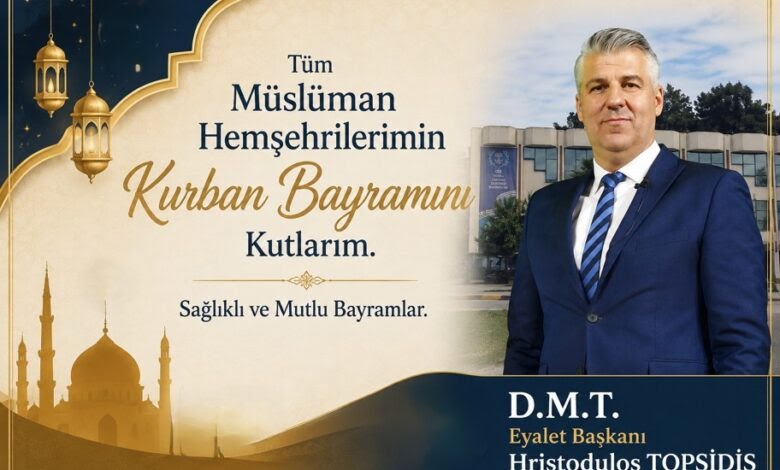
Intense reactions and a series of relentless questions are being raised in the local community of Thrace following the appearance of public holiday greetings from the Regional Governor of Eastern Macedonia and Thrace, Christodoulos Topsidis, and the Deputy Regional Governor of the Rodopi Regional Unit, Manolis Tapatzas, in minority-oriented publications in the Turkish language.
A move that for many crosses the boundaries of a simple holiday post and takes on a clear political imprint, especially at a time when the balances in Thrace require particular attention, delicate handling and institutional seriousness.
The choice to publish greetings in Turkish-language media outlets provokes intense concern. Many believe that such moves do not happen by chance, nor are they devoid of political motives, but are part of an effort to cultivate specific electoral audiences, in a manner that borders on vote-hunting.
Particularly sharp are the comments from citizens wondering why institutional representatives of the Greek state choose to address audiences through the Turkish language, at a time when the country’s official position speaks of a religious Muslim minority and not an ethnic Turkish minority. For many, such initiatives function as indirect legitimization of narratives that Ankara has been trying to promote in Thrace for years.
The Regional Governor’s response and the “silence” on the substance of the issue
In direct communication between Rodopipress and the Press Office of the Region of Eastern Macedonia & Thrace, the side of Mr. Christodoulos Topsidis rushed to distance itself, proceeding with clarifications.
According to the official response from the Region:
The specific greeting card is the product of autonomous creation and publication by the owner of the specific website, without prior approval or submission from the side of Regional Governor Mr. Christodoulos Topsidis or the Press Office. The only public greeting post by the Regional Governor for the holiday of Muslim fellow citizens for Kurban Bayram was published exclusively through his personal social media page… Consequently, any interpretations or comments based on this specific reproduction do not correspond to an official position or action of the Regional Governor of Eastern Macedonia and Thrace.
However, this response generates a new cycle of concern, as it highlights a peculiar institutional “silence” from the Regional Governor. If the publication of greetings in Turkish was indeed done exclusively on the initiative of minority publications, both the Regional Governor and the Deputy Regional Governor had all the time and ability to react immediately.
They should have requested the withdrawal or correction of the relevant publications from the moment they falsely displayed an official institutional approval. The continuation of the posts without any public, forceful distancing or legal action leaves the leadership of the Region of Eastern Macedonia and Thrace exposed.
The Deputy Regional Governor of the Rodopi Regional Unit, Manolis Tapatzas, moved on exactly the same wavelength, who in turn stated that the appearance of his own greeting card in Turkish was also the product of autonomous action by the minority journalist, without having given his own approval or instruction.
From greetings to… slaughters: The same pattern of “autonomy” and ambiguity
The issue of language use and communication games with the minority is not the only thing causing confusion these days. Rodopipress had recently highlighted (May 26, 2026) yet another serious contradiction from the regional authority, which moves in exactly the same spirit and dangerously balances between public health and political expediencies.
While the official circular from the Veterinary Directorate of the Region of Eastern Macedonia and Thrace imposes strict measures due to the continuing threat from sheep and goat pox and foot-and-mouth disease –making slaughter exclusively at approved slaughterhouses under veterinary supervision mandatory– Deputy Regional Governors Ridvan Molla Isa and Ahmet Pehlivan chose to send a completely different message through Turkish-language media (such as Gundem Gazetesi).
Their statement in Turkish was clear:
“Vatandaşlarımız kurbanlarını, hayvan taşımacılığı yapmadan bulundukları yerde ve hijyen kurallarına dikkat ederek kesebilirler.” (That is: “Citizens can slaughter their animals in the place where they are located, without transport and observing hygiene rules”).
This formulation leaves the window wide open for citizens to consider that they can carry out makeshift, uncontrolled slaughters in yards, villages or private spaces, effectively canceling the strict circular from the Region of Eastern Macedonia and Thrace which emphasizes that the services “do not guarantee the hygiene of the meat” outside slaughterhouses.
Here emerges exactly the same pattern as with the greeting cards: the two regional councilors obviously operated autonomously, sending a “relaxed” and reassuring message to the minority for petty political reasons, completely disregarding the official line of the Region.
The most troubling aspect, however, is that once again no one from the administration brought them back in line, leaving a critical public health issue to become prey to vote-seeking motives and communication chaos.
An uncontrolled spread could cause serious damage to livestock farming in Rodopi, Xanthi and Evros, with direct consequences for producers, traders and consumers.
Editor’s Comment
The problem in the management of Thrace by the current regional authority lies in the dangerous inconsistency between administrative seriousness and political communication. Whether it concerns major public health issues (such as slaughters amid epizootics), or issues of national and institutional order (such as greetings in Turkish), a consistent trend is observed: the official administration issues laws and rules, but the political personnel of the Region choose “relaxed,” ambiguous and equivocal formulations in minority publications to keep the electoral base satisfied.
Thrace is in a geopolitically and hygienically sensitive situation. Mr. Topsidis’s “silence” in the face of the unauthorized use of his name on Turkish-language greeting cards, combined with the wait for Mr. Tapatzas’s response and the complete absence of sanctions for the two Deputy Regional Governors who undermined the veterinary circular, simply intensify the sense that the Region prefers to turn a blind eye to specific audiences rather than defend its institutional role. The ambiguity and political balances on these issues are not simply communication errors; they are a real danger to the social cohesion and security of the place.
Source: RodopiPress Report / Press Office of the Region of Eastern Macedonia and Thrace
Edited by: Nikos Arvanitis







