
The Misuse of “Populism” as a Political Weapon of Devaluation
A Greek commentator questions how the term "populism" has become a catch-all anathema against any voice opposing the Mitsotakis government's policies, rather than its true political science definition.
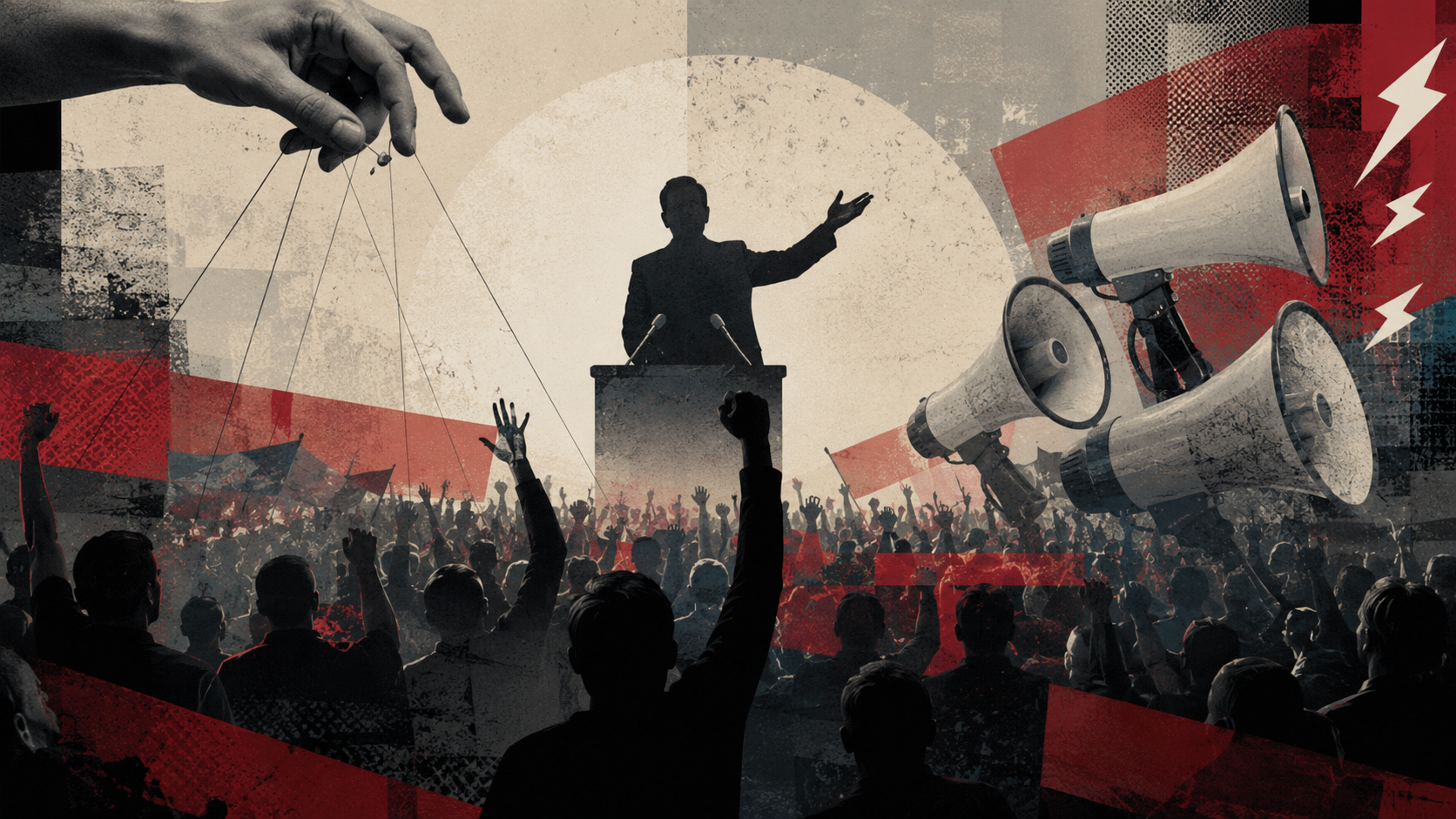

A few days ago, on a news television program I was participating in, a fellow commentator, referring to Antonis Samaras and the possibility of him forming a party, said that “he risks re-fueling the forces of populism” and shortly after, that “he’s giving a bonus to the forces of populism.” I wondered why he was characterizing Antonis Samaras as a “populist”—because that’s essentially what he was doing—and… all hell broke loose.
Yes, he didn’t call him a populist directly, but indirectly. Correct! However, he essentially called him a populist, as is customary for anyone supporting the Mitsotakis government and attempting to anathematize whoever opposes it. Any deviation from the government’s official line, any objection on, for example, national issues, any emphasis on demographics or immigration, equals “populism.”
Regardless of who was right in that particular confrontation, a question arises—or rather re-arises, since it’s been hovering unanswered for years: What exactly do we mean by the term “populism” today in Greece? In Greece, populism is customarily interpreted as “demagoguery.” Is opposition to the Simitis policy of appeasement that the government applies demagoguery? Is the anxiety about the survival of the Greek nation, which NIKI and HELLENIC SOLUTION often express, handout politics? And how did this word come to function as an automatic anathema against every voice that doesn’t bow to the dominant Mitsotakis narrative?
The international definition and the Greek distortion
In international political science, populism is not synonymous with falsehood or irresponsibility. Nor with demagoguery. According to the leading scholar Cas Mudde, it is a “thin-centered ideology”—an ideology with a thin core—that sees society divided into two camps: the “pure people” and the “corrupt elite.” The populist claims that politics must express the general will of the people (volonté générale) against elites that have become detached from reality.
I would supplement Mudde by saying: When the elite—there are always elites—is just and honest and is not corrupt and irrational, then populism loses its raison d’être and most likely the popular will itself shelves it.
In any case, if Greek users—or rather instrumentalizers—of the term “populism” had Mudde’s definition in mind, then they might possibly be right.
For Mudde, populism can be right-wing or left-wing, national or social. It doesn’t presuppose lies, nor automatically failure. In English, German, or French, the term often has a negative tinge, but it doesn’t function as a magic club to exclude ideas. In Greece, however, after the 1990s and especially after the crisis of the 2010s, “populism” became synonymous with demagoguery, false promises, and handout politics. Every politician who listens to the people and doesn’t follow the “correct” line from Brussels or the domestic elites is labeled a populist.
The Samaras occasion and the logic of “whatever isn’t Mitsotakis is populism”
Antonis Samaras, former prime minister and historic figure of New Democracy, was expelled because he insisted on a hard line on Greek-Turkish relations, the Skopje issue, and matters of national dignity. And immediately the characterization emerged: he strengthens populism.
The colleague who said that “he risks re-fueling the forces of populism,” obviously meant that “he’s giving a bonus to Tsipras,” but in this way he essentially behaves… “populistically”—at least as he himself understands it. Why? Because he activates the basic scare tactic that New Democracy will use ahead of the elections, which is none other than “Vote ND so Tsipras doesn’t win!” It doesn’t matter if you disagree, for example, with Mitsotakis’s ND on social, ideological, defense, and diplomatic issues. No matter how much you disagree, Tsipras is worse and therefore: DON’T BECOME AN OBSTACLE TO ND!
So, questioning a foreign policy that many see as submissive is “populism”? The intense concern about the demographic problem—which threatens the very existence of the nation—is demagoguery? The refusal to accept that “it’s the economy, stupid” (Bill Clinton’s famous dictum) and that everything else (identity, security, culture) is secondary, is that irresponsibility?
These positions are not “deceiving the people.” They are responsible politics. They are recognition that society is not just a consumer mob that wants subsidies, but a people with history, identity, and existential concerns. When large segments of the population see criminality as having mass illegal immigration as its main source, see alteration of the demographic composition, loss of border control, and an elite telling them “don’t worry, it’s progress,” the reaction is not pathology. It’s a survival instinct.
From Brussels to Greek parrots
The abuse of the term is not accidental. It became more intense when the rise of patriotic, conservative, and anti-systemic forces became visible across Europe: from France and Italy to Hungary and the Netherlands. The power centers in Brussels and the mainstream media needed an easy verbal anathema. “Populism” and “far-right” became the new labels for anyone who questioned open immigration, the loss of national sovereignty, or the woke agenda.
We here, faithful to our role as regional parrots of European political correctness, adopted the term without a second thought. We didn’t bother to wonder: Does the English word populism have the same meaning as the Greek “λαϊκισμός”? No! Instead, we turned the word into a club against every voice that reminds us that there is still a “people” beyond polls and focus groups. The elitist mentality is clear:
We (the educated, the cosmopolitan, the correct ones) know what’s good for you. Those of you who disagree are manipulable, backward, populists.
Responsibility, not demagoguery
Real demagoguery is promising everything to everyone at no cost. Real irresponsibility is ignoring existential threats so as not to be characterized as a “populist.” Samaras, Velopoulos, Natsios, and those who think like them are not “encouraging populism.” They simply refuse to pretend that all is well while Greece is shrinking demographically, weakening nationally, and being transformed into a colony of ideas and populations.
Democracy doesn’t function when elites scorn the people’s concerns and label them pathology. Nor when they vilify the people and those who listen to them with vulgar expressions, like “patriots of the lentil” or “Christian Taliban” or “ethno-lunatics”! It functions when politicians are forced to listen. If this is called “populism” by some, then perhaps the problem isn’t the people or those who listen to them, but those who have lost touch with them.
The time has come to clarify the meaning. Not to blindly defend every opposition, but to defend the very possibility of a healthy, realistic, and patriotic discussion. Without verbal taboos and elitist anathemas. The people are not stupid. And those who listen to them are not automatically demagogues. They are politicians doing their job.





