Necessary Cookies

Required for the site to function. Cannot be disabled.

Analytics Cookies

Help us understand how visitors interact with our site (Google Analytics via GTM).

Marketing Cookies

Used to track visitors and deliver personalised advertisements.

We use cookies to enhance your browsing experience and analyse site traffic. By clicking Accept All, you consent to our use of cookies. Privacy Policy
NewsFire Global
Home News Europe World Christianity Culture Wars Opinion Video
Information
About Us Authors Advertising Terms & Conditions Privacy Policy Contact
R2B Media
R2B NEWSFIRE.GR PAPAFOTIS.GR THRACTION HELLENIC CONSERVATIVES RIGHT2THEBONE YT
News Christianity

Klidonas: The ancestral custom with bonfire, silent water and pies

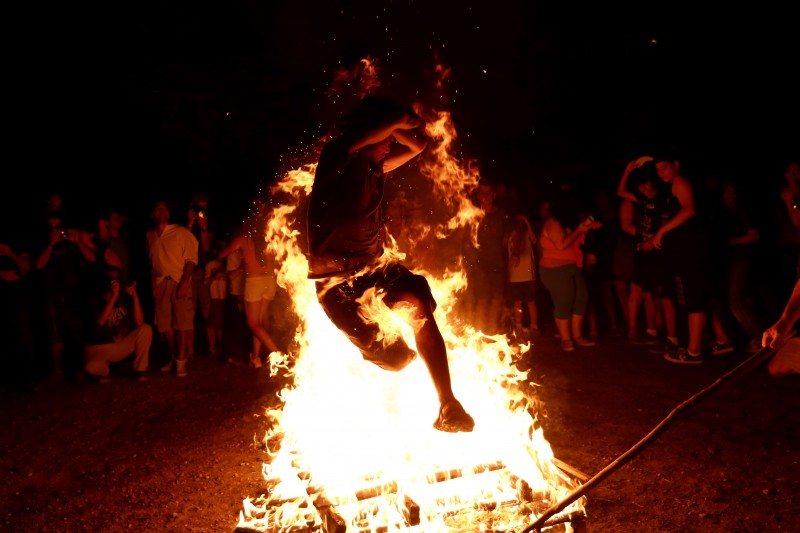
Klidonas, an ancient Greek divination festival incorporated into Saint John the Baptist's feast, involves unmarried girls using silent water and personal items to learn about their future husbands.

Dimitris Papafotis
Dimitris Papafotis Editor in Chief
JUNE 24, 2026 AT 2:00 PM

Klidonas is one of the oldest folk customs preserved in various parts of Greece and has been incorporated into the great feast of the birth of Saint John the Baptist.

The folk festival that comes from the depths of Greek antiquity is a divination process that, according to ancestral tradition, reveals to unmarried girls details about their future husband. The celebrations take place on June 23 and 24, including the summer solstice.

The word “Klidonas” has ancient roots and is connected with the concept of fame, omen, and prophetic message. The people call Saint John “rizikaris” and “fanistis,” as they believe he brings luck (rizikaris) and reveals (fanistis) destiny.

The two-day festival traditionally includes three phases: preparation with lighting fires and carrying “silent water” on the eve, exposing the vessel to the stars and opening it on the day itself with the “rizika,” followed by celebration.

On the eve of Saint John’s Day, the boys would light three large fires in a row as soon as dusk fell, using the May Day wreaths as kindling. Everyone—boys, girls, and married people—jumped over the fires holding a stone on their heads. They believed that the triple jump benefits health and drives away fleas and bedbugs.

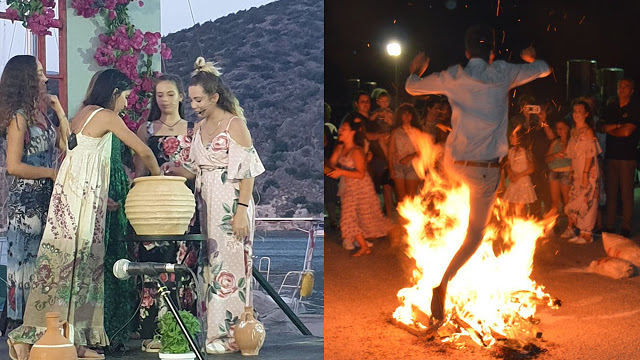
The unmarried girls would gather in a house and assign one of them, usually a Maria with both parents living, to bring “silent water” from a well or spring. The water was called that because during the journey no one was allowed to speak.

At the house they would empty it into a clay vessel—goumari in Agiassos, Lesvos—and each girl would throw in a personal item: a ring, earring, button, or thimble.

The vessel was covered with cloth and placed on a terrace, outdoors, or under a rose bush so the stars could see it. The next morning they would bring it inside before the sun saw it.

On the day itself, whoever had locked the vessel would open it. As the items came out in random order, improvised couplets-prophecies were recited about their owner. Additionally, the girls paid attention to the first name or word they heard on the street returning to their homes, connecting it with their fate.

Agiassos, Lesvos – Ta Kapsala and Klidonas

In Agiassos, the mountainous main village of Lesvos about 25 kilometers from Mytilene, the customs of Kapsala (Agistrou) and Klidonas are revived through the initiative of the Cultural Carnival Association of Agiassos “O Satyros.”

The word “Agistrou” comes from “agos,” meaning pollution, and refers to the ritual of lighting and jumping over the fire for purification.

The procession begins on Sunday, June 23 at 6:00 PM from Kampoudi with a traditional band, a stop for dancing at Stavri, and ends at the Market. The fire will be lit, the agistro will follow, the traditional tiganopita will be roasted, and the Klidonas will come out. Santouris and stringed instruments from the Reading Room will be heard, while the youth section of the association will dance.
Paros – Exorcising evil spirits

In the villages of Paros from June 21 to 23, large fires are lit and the May Day wreaths are burned. Jumping over the fires drives away evil spirits, while the tradition connecting the custom with revealing the future spouse is also maintained.

Particularly well-known are the festivals in Prodromos, Naoussa, and Alyki, where seafood appetizers and traditional music keep people going until morning. Prodromos honors its patron saint, Saint John the Baptist, with religious events, while in Alyki the burning of the Maydes takes place on the beach. Similar events are also held in other villages such as Lefkes, Kostos, and Marpissa.

Aitoliko – Ta Rizikaria

In Aitoliko, ten kilometers northwest of Messolonghi, the Cultural & Educational Association “To Aitoliko” revives the custom with the event “Rizikaria – At the fires of Saint John.” The festival will take place on Sunday, June 28 at 9:15 PM at the Western waterfront (Statue).
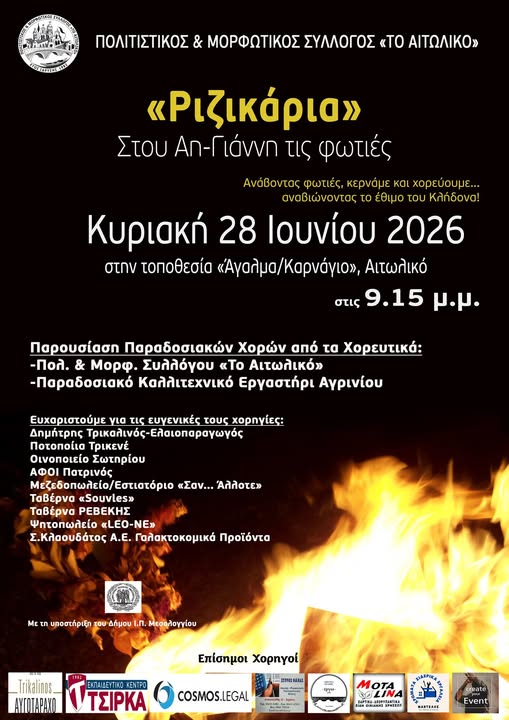
The association, founded in 1982, consistently contributes to the culture of the area. Local traditions continue to come alive every year, keeping the folk memory around Klidonas alive.


Share:
Dimitris Papafotis
Dimitris Papafotis

Dimitris Papafotis is the editor-in-chief of NewsFire.GR. He was born and raised in Athens. He studied at the Journalism Workshop (1991-1993). He currently lives in Pyrgos, Ilia, where he has been active in radio and various newspapers, while also maintaining his personal blog, Papafotis.gr.

Klidonas is one of the oldest folk customs preserved in various parts of Greece and has been incorporated into the great feast of the birth of Saint John the Baptist.

The folk festival that comes from the depths of Greek antiquity is a divination process that, according to ancestral tradition, reveals to unmarried girls details about their future husband. The celebrations take place on June 23 and 24, including the summer solstice.

The word “Klidonas” has ancient roots and is connected with the concept of fame, omen, and prophetic message. The people call Saint John “rizikaris” and “fanistis,” as they believe he brings luck (rizikaris) and reveals (fanistis) destiny.

The two-day festival traditionally includes three phases: preparation with lighting fires and carrying “silent water” on the eve, exposing the vessel to the stars and opening it on the day itself with the “rizika,” followed by celebration.

On the eve of Saint John’s Day, the boys would light three large fires in a row as soon as dusk fell, using the May Day wreaths as kindling. Everyone—boys, girls, and married people—jumped over the fires holding a stone on their heads. They believed that the triple jump benefits health and drives away fleas and bedbugs.

The unmarried girls would gather in a house and assign one of them, usually a Maria with both parents living, to bring “silent water” from a well or spring. The water was called that because during the journey no one was allowed to speak.

At the house they would empty it into a clay vessel—goumari in Agiassos, Lesvos—and each girl would throw in a personal item: a ring, earring, button, or thimble.

The vessel was covered with cloth and placed on a terrace, outdoors, or under a rose bush so the stars could see it. The next morning they would bring it inside before the sun saw it.

On the day itself, whoever had locked the vessel would open it. As the items came out in random order, improvised couplets-prophecies were recited about their owner. Additionally, the girls paid attention to the first name or word they heard on the street returning to their homes, connecting it with their fate.

Agiassos, Lesvos – Ta Kapsala and Klidonas

In Agiassos, the mountainous main village of Lesvos about 25 kilometers from Mytilene, the customs of Kapsala (Agistrou) and Klidonas are revived through the initiative of the Cultural Carnival Association of Agiassos “O Satyros.”

The word “Agistrou” comes from “agos,” meaning pollution, and refers to the ritual of lighting and jumping over the fire for purification.

The procession begins on Sunday, June 23 at 6:00 PM from Kampoudi with a traditional band, a stop for dancing at Stavri, and ends at the Market. The fire will be lit, the agistro will follow, the traditional tiganopita will be roasted, and the Klidonas will come out. Santouris and stringed instruments from the Reading Room will be heard, while the youth section of the association will dance.

Paros – Exorcising evil spirits

In the villages of Paros from June 21 to 23, large fires are lit and the May Day wreaths are burned. Jumping over the fires drives away evil spirits, while the tradition connecting the custom with revealing the future spouse is also maintained.

Particularly well-known are the festivals in Prodromos, Naoussa, and Alyki, where seafood appetizers and traditional music keep people going until morning. Prodromos honors its patron saint, Saint John the Baptist, with religious events, while in Alyki the burning of the Maydes takes place on the beach. Similar events are also held in other villages such as Lefkes, Kostos, and Marpissa.

Aitoliko – Ta Rizikaria

In Aitoliko, ten kilometers northwest of Messolonghi, the Cultural & Educational Association “To Aitoliko” revives the custom with the event “Rizikaria – At the fires of Saint John.” The festival will take place on Sunday, June 28 at 9:15 PM at the Western waterfront (Statue).

The association, founded in 1982, consistently contributes to the culture of the area. Local traditions continue to come alive every year, keeping the folk memory around Klidonas alive.
