Necessary Cookies

Required for the site to function. Cannot be disabled.

Analytics Cookies

Help us understand how visitors interact with our site (Google Analytics via GTM).

Marketing Cookies

Used to track visitors and deliver personalised advertisements.

We use cookies to enhance your browsing experience and analyse site traffic. By clicking Accept All, you consent to our use of cookies. Privacy Policy
NewsFire Global
Home News Europe World Christianity Culture Wars Opinion
Information
About Us Authors Advertising Terms & Conditions Privacy Policy Contact
R2B Media
R2B NEWSFIRE.GR PAPAFOTIS.GR THRACTION HELLENIC CONSERVATIVES RIGHT2THEBONE YT
Opinion Europe

Jihad and the Future of Europe

The article traces three generations of jihadist fighters targeting Europe, culminating with ISIS-era attacks influenced by Abu Musab al-Suri's strategic manifesto promoting decentralized terrorism.
MAY 26, 2026 AT 6:22 PM

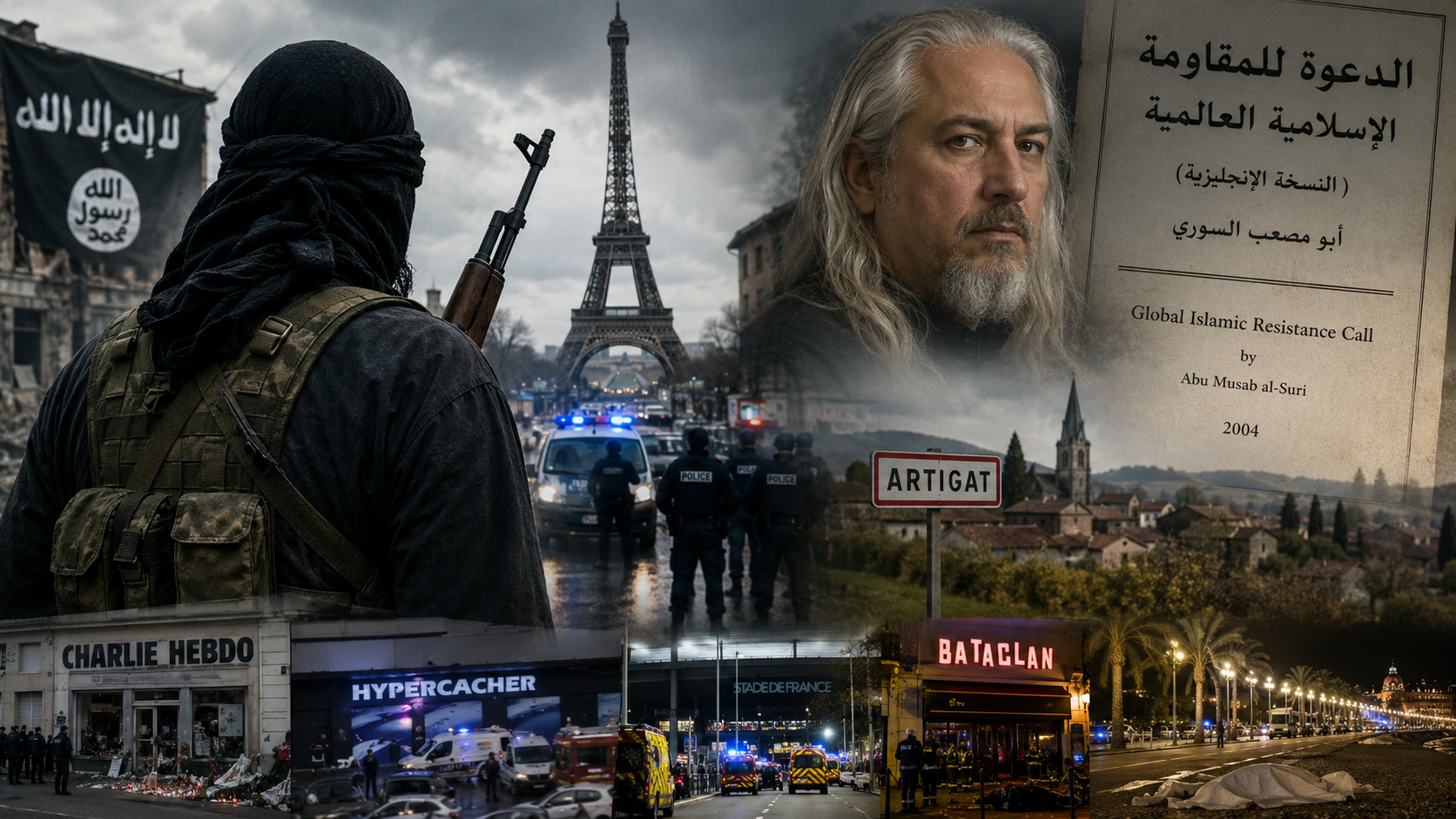
The first generation of jihad (holy war) fighters who attempted to penetrate Europe, without success however, came from the conflicts and civil wars in Algeria, Egypt, Bosnia and Chechnya. The second was after Al-Qaeda’s attack on the Twin Towers and the Pentagon in the USA and the subsequent terrorist attacks in London, Madrid and the murders by Mohammed Merah in Toulouse. The culmination of the jihadist assault, however, came with the third generation of fighters, with the expansion of Islamic migration (hijrah) from Iraq and Syria and the emergence of the Islamic State, but mainly after the posting of the “Global Islamic Resistance Call” (in Arabic Da’wat al-Muqāwama al-Islāmiyya al-‘Ālamiyya) by Syrian theorist Abu Musab al-Suri, which was written in the early 2000s.

At the same time, a Muslim microcosm was created south of Albi in France, in the remote small village of Artigat, under the white sheikh (due to his silver-gray long hair) Abdallah, or Olivier Corel. With Salafism views dominant and teaching Wahhabism and “Total Islam,” Artigat became a pole of attraction for neophyte Islamists from the banlieues (extremely poor neighborhoods) of major French cities. Almost all the cream of the crop of subsequent jihadist criminals passed through there. The work of this third generation of jihad fighters included the massacres in Paris at the satirical magazine Charlie Hebdo, at the Jewish supermarket Hyper Cacher, at the Stade de France stadium, at the Bataclan music hall and on the beach in Nice.

Al-Suri’s “Call” is not an organization but an extensive strategic text/manifesto. It is considered one of the most important theoretical works of contemporary global jihadism.

His role in the spread of jihad in Europe was primarily ideological and strategic, not operational in the classical sense. The text profoundly influenced the way organizations and “lone wolves” understood their actions in the West. Key points of his influence are, on the one hand, the decentralization of jihad, because large hierarchical organizations like Al-Qaeda were vulnerable to Western security services after September 11th. Al-Suri proposed small autonomous cells, “leaderless jihad,” or isolated actors who radicalize themselves through propaganda and the internet.

Al-Suri also proposed targeting Europe’s Muslim communities where young Muslims of the second or third generation could be recruited. Al-Suri spoke of “grassroots jihad” within European societies. His theory was based on the idea that terrorist attacks in Europe would provoke harsh reactions, these reactions would increase the alienation of parts of the Muslim communities, and thus further radicalization would be facilitated. That is, he sought a vicious circle between jihadist violence and anti-Muslim polarization.

For the future, then, the only solution is halting migration and not persecution of Muslim communities. For countries like ours, where the Islamic population is not yet large, stopping the influx of Muslims is vital for the future.

First published at Newideas.gr

Share:
Andreas Andrianopoulos

Andreas Andrianopoulos (Piraeus, 1946) is a Greek politician, former minister, and member of parliament for New Democracy, with studies in Political Science in Athens and Comparative Politics at the Universities of Kent, Cambridge, and Oslo. He served as Minister of Commerce (1990-1991), Minister of Industry, Energy and Technology (1991-1992), and Minister of Culture (1992-1993), while also holding the position of Mayor of Piraeus (1982-1990). As the son of Giannis Andrianopoulos, one of the founders of Olympiacos, he is connected to the history of the club. He is also an author and columnist, with a significant contribution to public discourse.

The first generation of jihad (holy war) fighters who attempted to penetrate Europe, without success however, came from the conflicts and civil wars in Algeria, Egypt, Bosnia and Chechnya. The second was after Al-Qaeda’s attack on the Twin Towers and the Pentagon in the USA and the subsequent terrorist attacks in London, Madrid and the murders by Mohammed Merah in Toulouse. The culmination of the jihadist assault, however, came with the third generation of fighters, with the expansion of Islamic migration (hijrah) from Iraq and Syria and the emergence of the Islamic State, but mainly after the posting of the “Global Islamic Resistance Call” (in Arabic Da’wat al-Muqāwama al-Islāmiyya al-‘Ālamiyya) by Syrian theorist Abu Musab al-Suri, which was written in the early 2000s.

At the same time, a Muslim microcosm was created south of Albi in France, in the remote small village of Artigat, under the white sheikh (due to his silver-gray long hair) Abdallah, or Olivier Corel. With Salafism views dominant and teaching Wahhabism and “Total Islam,” Artigat became a pole of attraction for neophyte Islamists from the banlieues (extremely poor neighborhoods) of major French cities. Almost all the cream of the crop of subsequent jihadist criminals passed through there. The work of this third generation of jihad fighters included the massacres in Paris at the satirical magazine Charlie Hebdo, at the Jewish supermarket Hyper Cacher, at the Stade de France stadium, at the Bataclan music hall and on the beach in Nice.

Al-Suri’s “Call” is not an organization but an extensive strategic text/manifesto. It is considered one of the most important theoretical works of contemporary global jihadism.

His role in the spread of jihad in Europe was primarily ideological and strategic, not operational in the classical sense. The text profoundly influenced the way organizations and “lone wolves” understood their actions in the West. Key points of his influence are, on the one hand, the decentralization of jihad, because large hierarchical organizations like Al-Qaeda were vulnerable to Western security services after September 11th. Al-Suri proposed small autonomous cells, “leaderless jihad,” or isolated actors who radicalize themselves through propaganda and the internet.

Al-Suri also proposed targeting Europe’s Muslim communities where young Muslims of the second or third generation could be recruited. Al-Suri spoke of “grassroots jihad” within European societies. His theory was based on the idea that terrorist attacks in Europe would provoke harsh reactions, these reactions would increase the alienation of parts of the Muslim communities, and thus further radicalization would be facilitated. That is, he sought a vicious circle between jihadist violence and anti-Muslim polarization.

For the future, then, the only solution is halting migration and not persecution of Muslim communities. For countries like ours, where the Islamic population is not yet large, stopping the influx of Muslims is vital for the future.

First published at Newideas.gr