
Death Threats Against Viktor Orbán Prompt Zelensky’s Loss of Composure
Zelensky’s harsh threat against Hungary’s Orban amid EU aid disputes highlights deep geopolitical tensions over Russian oil supplies and upcoming Hungarian elections, straining Ukraine-EU ties.
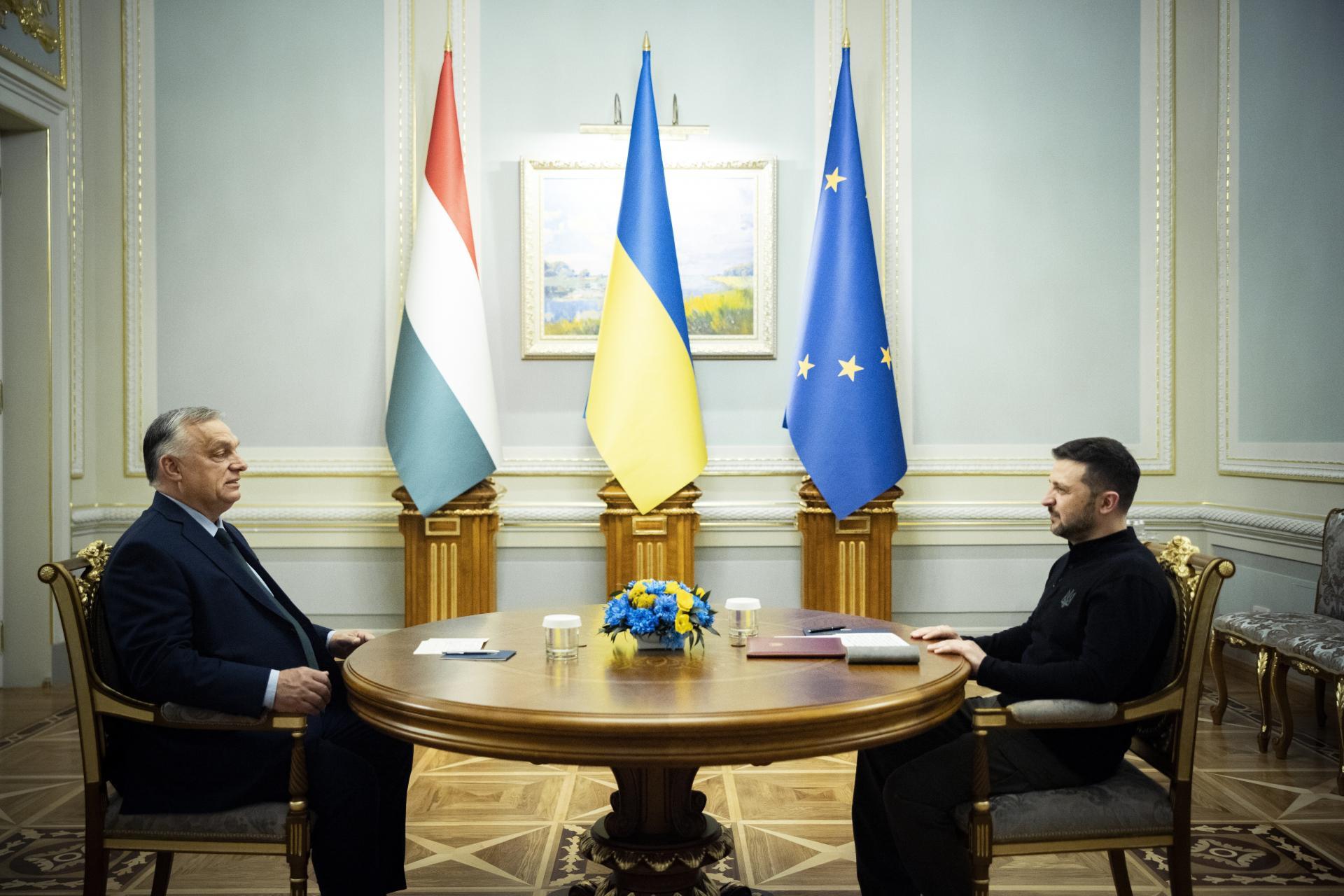

“We hope that no one within the EU will block the €90 billion. Otherwise, we will give this person’s address to our armed forces, to our own. Let them call him and speak to him in their own language.” These words, which could have been a line from the sequel to “The Godfather,” were spoken by Volodymyr Zelensky on March 6 in an address to Viktor Orbán. The European Commission itself, although unwilling to take the side of the Hungarian prime minister against the head of the Ukrainian state, was forced to defend him! “This kind of language is unacceptable,” said its spokesperson, Olof Gjell, for whom “there must be no threats against EU member states.”
- Written by Étienne Lombard
Euros in exchange for oil
How could Volodymyr Zelensky lose control like this and make such violent remarks against Viktor Orbán, reminiscent of mafia threats from the era of gang wars? The relations between the two men were never friendly. However, as always, emotions play a marginal role in relations between states. These are primarily determined by each party’s interests. Viktor Orbán is known for the relentless defense of Hungarian interests. And at the heart of this matter lies oil. Let us take a brief look back.
As remnants of the Soviet era, many former satellite states of Moscow and Central and Eastern European countries continue to receive oil from their former big brother. Russia supplies black gold to Hungary and Slovakia, as well as to Belarus, Poland, the Czech Republic, Austria, and Germany via the Druzhba pipeline (which means “friendship”). Part of the pipeline route passes through Ukraine. This vital lifeline explains the good relations that Budapest and Bratislava maintain with Moscow, far more than a hypothetical ideological convergence between Viktor Orbán and Vladimir Putin. It also explains the intense tensions between Kyiv and Budapest from the outset of the Russian attack on Ukraine in 2022. Since then, there have been plenty of reasons for irritation.
The Druzhba pipeline, the source of the dispute
In May 2023, the Russian oil company Transneft, which operates the Druzhba pipeline, confirmed the attack against it by Ukrainians at the Briansk supply station. In August 2025, three new attacks caused damage at various points along the pipeline, resulting in a disruption of oil supply to Hungary and Slovakia. In January 2026, another attack again hit the Druzhba pipeline.
While Hungary suspected Ukraine of delaying the restoration of oil flow, Volodymyr Zelensky initially appeared reassuring. “According to current information, in a month to a month and a half, this pipeline will be able to be put back into operation”, he declared on March 5, before making a completely different statement: “To be honest, I will not restore it. That is my position.” Why this sudden change of stance? “Because it is Russian oil. There are certain principles that have no price. They are killing us, and we are supposed to provide oil to Orbán because poor Orbán cannot win the elections without this oil.” Zelensky was referring to the parliamentary elections in Hungary on April 12, in which Viktor Orbán is currently not the favorite in the polls. The latter’s response was as clear as it was swift. Hungary will therefore exercise a veto on the EU’s €90 billion loan to Ukraine.
“Unacceptable” statements
These €90 billion were the subject of the death threat received by Volodymyr Zelensky on March 6. And this threat was condemned by Guillaume Bigot, following Brussels, as president of the French-Hungarian friendship group of the National Assembly. “I express the National Assembly’s support for Viktor Orbán,” he said on his X account. “Threats against a European leader are completely unacceptable!” reminded the member of the National Rally (RN) from Belfort, who agreed to return to BV on this serious incident. “I believe this is retaliation, a reaction from Ukraine against Hungary.” But the Hungarian veto was itself a measure of retaliation. “We, the French, must therefore distance ourselves somewhat from this chain of events,” assesses Guillaume Bigot, for whom, on the one hand, it is understandable that Hungary worries about the prospect of no longer having this hydrocarbon supply reaching its territory. This will be very problematic for Hungary and will cost it dearly.” But on the other hand, “we can also put ourselves in the position of the Ukrainian government, which needs these €90 billion not to sink.” It is therefore logical that there is “a confrontation, because both sides are anxious.” And, the deputy from Belfort explains, “if I reacted as president of the French-Hungarian friendship group, it is because Volodymyr Zelensky’s statement is unacceptable, given that the two countries are not at war.” And “besides, as far as I understand, relations between the Ukrainian and Hungarian ambassadors in France are rather good and cordial,” he notes.
The question remains: why is Volodymyr Zelensky escalating tensions to the point of threatening Viktor Orbán with death? For Guillaume Bigot, the Hungarian probably saw in “the American interventions against Venezuela and Iran, the capture of Maduro and the death of Khamenei, a way to calm the Russians and the Chinese and, therefore, a promise of disengagement.” This new situation would not be without consequence. “Volodymyr Zelensky feels like he is growing wings,” continues Guillaume Bigot, “and I think there is a form of nervousness in him, as he has lately been challenged by Ukrainians. Many are demanding elections, which he is not sure to win…”.
Although we should not expect the situation between Kyiv and Budapest to escalate much before the Hungarian elections in April, it is in neither side’s interest for it to worsen.
Source: BVoltaire





