Necessary Cookies

Required for the site to function. Cannot be disabled.

Analytics Cookies

Help us understand how visitors interact with our site (Google Analytics via GTM).

Marketing Cookies

Used to track visitors and deliver personalised advertisements.

We use cookies to enhance your browsing experience and analyse site traffic. By clicking Accept All, you consent to our use of cookies. Privacy Policy
NewsFire Global
Home News Europe World Christianity Culture Wars Opinion Video
Information
About Us Authors Advertising Terms & Conditions Privacy Policy Contact
R2B Media
R2B NEWSFIRE.GR PAPAFOTIS.GR THRACTION HELLENIC CONSERVATIVES RIGHT2THEBONE YT
News Europe

European Parliament Approves Digital Euro Legislation

The European Parliament's economic committee has approved draft legislation for a digital euro that could launch by 2029, framing it as a sovereign alternative to private payment systems.

Dimitris Papafotis
Dimitris Papafotis Editor in Chief
JUNE 23, 2026 AT 8:27 PM
brusselssignal.eu
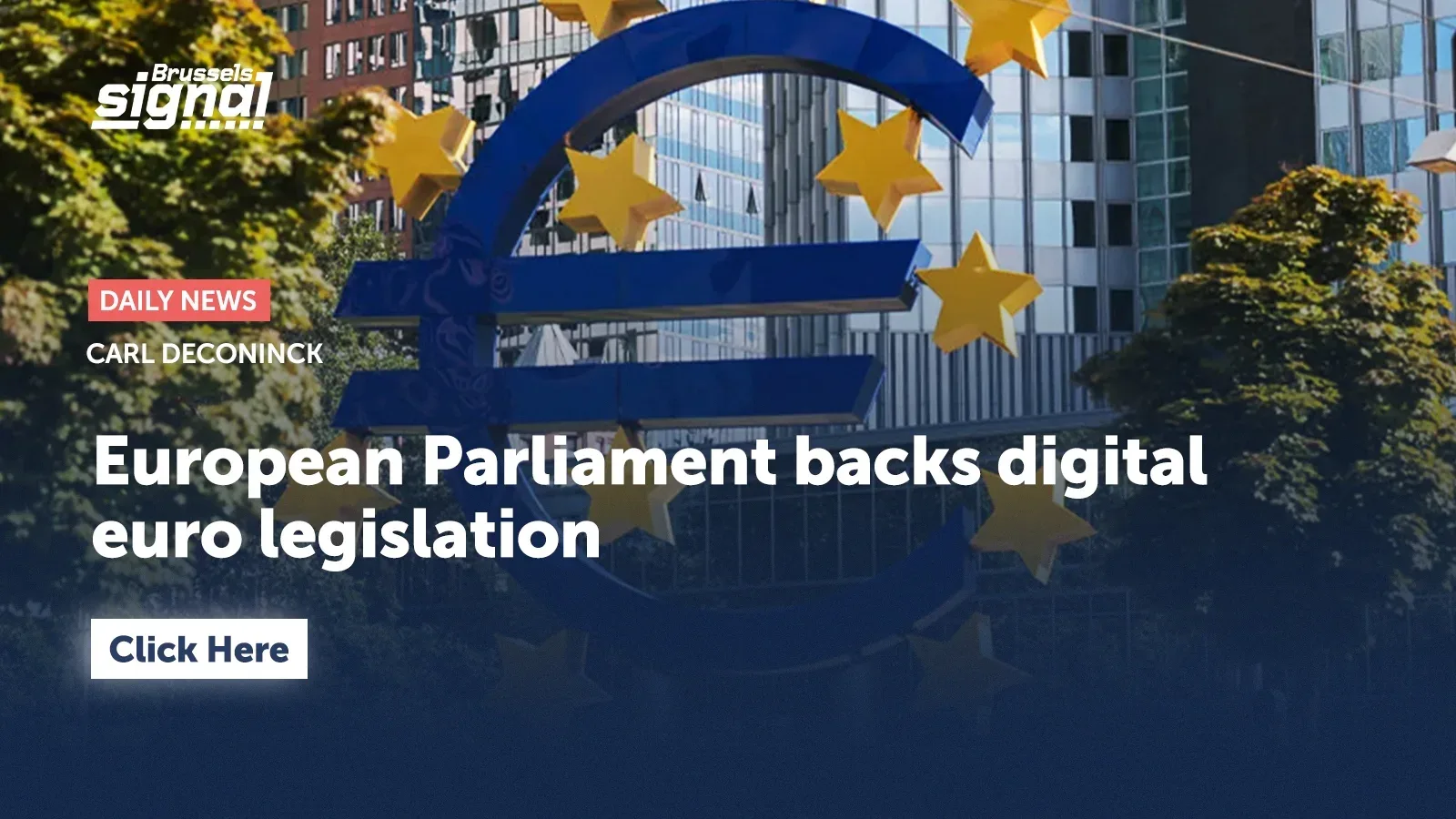
Photo: brusselssignal.eu

The Parliament’s Committee on Economic and Monetary Affairs has backed the draft regulation on a digital euro, according to Brussels Signal, clearing a significant procedural barrier and advancing the project toward formal trilogue negotiations with the Council and Commission.

The committee vote follows a February 2026 plenary resolution that endorsed both online and offline versions of the digital currency, and aligns with the Council’s negotiating mandate issued in December 2025.

The European Central Bank has signaled it could be prepared to launch the digital euro by 2029 if lawmakers finalize legislation this year or next. The project was first formally proposed by the Commission in June 2023.

Monetary Sovereignty or Government Control?

Supporters of the digital euro frame it as a public digital alternative to physical cash in an era when private payment systems and foreign stablecoins are expanding their reach. EU officials argue that Europe risks surrendering control over its monetary infrastructure as cash usage declines, particularly among younger users and in contactless transactions.

Citizens and businesses increasingly depend on private intermediaries, many of them non-European. A central bank digital currency would ensure continued access to public money in digital form, strengthen the euro’s position in payments, and provide a resilient, pan-European alternative to fragmented national systems or foreign-controlled card networks.

The ECB and Commission invoke strategic autonomy as a key rationale. European payments remain dominated by American companies including Visa, Mastercard, PayPal, Google Pay, and Apple Pay. Only recently has a European initiative emerged with Wero.

With the rise of dollar-pegged stablecoins and China’s digital yuan experiments, Brussels presents the digital euro as a tool to protect monetary sovereignty and reduce dependence on external payment infrastructure. Offline functionality is promoted as a resilience feature, enabling payments even during network failures.

How the Digital Euro Would Function

The digital euro would represent a direct claim on the Eurosystem, issued by the ECB but distributed through supervised intermediaries, primarily banks. Users would hold it in digital wallets or accounts, with proposed holding limits ranging from €500 to €3,000 per person designed to prevent large-scale shifts from bank deposits.

The system would support both online instant payments and offline functionality similar to cash, with the latter offering enhanced privacy. Transaction details would remain known only to payer and payee. Basic use is intended to be free for individuals, while merchants would face acceptance obligations in many scenarios.

The architecture employs a two-tier structure to preserve the banking sector’s role in credit provision and customer relationships. Legal tender status and mandatory acceptance rules remain under discussion, which would give the digital euro a competitive advantage over purely private solutions.

For consumers, proponents promise seamless, low-cost or no-cost payments across the euro area including peer-to-peer transfers, in-store purchases, and online transactions without requiring multiple apps or foreign cards. For the public sector and policymakers, it offers a programmable or programmable-adjacent tool for targeted disbursements in future crises, though current designs avoid full programmability to maintain public trust.

Businesses could benefit from faster settlement and potentially lower fees in a more competitive payments market.

Banking Sector Sounds Alarm on Stability Risks

Critics view the project as unnecessary at best and dangerous at worst. Several economists and former policymakers argue that Europe already possesses efficient payment systems and that the digital euro risks solving non-existent problems while introducing new ones.

A major concern centers on financial stability. In times of banking stress, a digital euro perceived as safer than commercial bank deposits could trigger rapid outflows, even with holding limits in place. This could raise funding costs for banks and ultimately increase borrowing rates for households and businesses.

The European Banking Federation and several national banking associations have warned that the digital euro could trigger large-scale deposit outflows, particularly during periods of financial uncertainty, even with the proposed holding limits.

With information from Brussels Signal

Share:
Dimitris Papafotis
Dimitris Papafotis

Dimitris Papafotis is the editor-in-chief of NewsFire.GR. He was born and raised in Athens. He studied at the Journalism Workshop (1991-1993). He currently lives in Pyrgos, Ilia, where he has been active in radio and various newspapers, while also maintaining his personal blog, Papafotis.gr.

brusselssignal.eu
Photo: brusselssignal.eu

The Parliament’s Committee on Economic and Monetary Affairs has backed the draft regulation on a digital euro, according to Brussels Signal, clearing a significant procedural barrier and advancing the project toward formal trilogue negotiations with the Council and Commission.

The committee vote follows a February 2026 plenary resolution that endorsed both online and offline versions of the digital currency, and aligns with the Council’s negotiating mandate issued in December 2025.

The European Central Bank has signaled it could be prepared to launch the digital euro by 2029 if lawmakers finalize legislation this year or next. The project was first formally proposed by the Commission in June 2023.

Monetary Sovereignty or Government Control?

Supporters of the digital euro frame it as a public digital alternative to physical cash in an era when private payment systems and foreign stablecoins are expanding their reach. EU officials argue that Europe risks surrendering control over its monetary infrastructure as cash usage declines, particularly among younger users and in contactless transactions.

Citizens and businesses increasingly depend on private intermediaries, many of them non-European. A central bank digital currency would ensure continued access to public money in digital form, strengthen the euro’s position in payments, and provide a resilient, pan-European alternative to fragmented national systems or foreign-controlled card networks.

The ECB and Commission invoke strategic autonomy as a key rationale. European payments remain dominated by American companies including Visa, Mastercard, PayPal, Google Pay, and Apple Pay. Only recently has a European initiative emerged with Wero.

With the rise of dollar-pegged stablecoins and China’s digital yuan experiments, Brussels presents the digital euro as a tool to protect monetary sovereignty and reduce dependence on external payment infrastructure. Offline functionality is promoted as a resilience feature, enabling payments even during network failures.

How the Digital Euro Would Function

The digital euro would represent a direct claim on the Eurosystem, issued by the ECB but distributed through supervised intermediaries, primarily banks. Users would hold it in digital wallets or accounts, with proposed holding limits ranging from €500 to €3,000 per person designed to prevent large-scale shifts from bank deposits.

The system would support both online instant payments and offline functionality similar to cash, with the latter offering enhanced privacy. Transaction details would remain known only to payer and payee. Basic use is intended to be free for individuals, while merchants would face acceptance obligations in many scenarios.

The architecture employs a two-tier structure to preserve the banking sector’s role in credit provision and customer relationships. Legal tender status and mandatory acceptance rules remain under discussion, which would give the digital euro a competitive advantage over purely private solutions.

For consumers, proponents promise seamless, low-cost or no-cost payments across the euro area including peer-to-peer transfers, in-store purchases, and online transactions without requiring multiple apps or foreign cards. For the public sector and policymakers, it offers a programmable or programmable-adjacent tool for targeted disbursements in future crises, though current designs avoid full programmability to maintain public trust.

Businesses could benefit from faster settlement and potentially lower fees in a more competitive payments market.

Banking Sector Sounds Alarm on Stability Risks

Critics view the project as unnecessary at best and dangerous at worst. Several economists and former policymakers argue that Europe already possesses efficient payment systems and that the digital euro risks solving non-existent problems while introducing new ones.

A major concern centers on financial stability. In times of banking stress, a digital euro perceived as safer than commercial bank deposits could trigger rapid outflows, even with holding limits in place. This could raise funding costs for banks and ultimately increase borrowing rates for households and businesses.

The European Banking Federation and several national banking associations have warned that the digital euro could trigger large-scale deposit outflows, particularly during periods of financial uncertainty, even with the proposed holding limits.

With information from Brussels Signal