Necessary Cookies

Required for the site to function. Cannot be disabled.

Analytics Cookies

Help us understand how visitors interact with our site (Google Analytics via GTM).

Marketing Cookies

Used to track visitors and deliver personalised advertisements.

We use cookies to enhance your browsing experience and analyse site traffic. By clicking Accept All, you consent to our use of cookies. Privacy Policy
NewsFire Global
Home News Europe World Christianity Culture Wars Opinion Video
Information
About Us Authors Advertising Terms & Conditions Privacy Policy Contact
R2B Media
R2B NEWSFIRE.GR PAPAFOTIS.GR THRACTION HELLENIC CONSERVATIVES RIGHT2THEBONE YT
News World

Moscow Oil Refinery Explodes After Ukraine Drone Strike

Ukrainian forces struck a Moscow oil refinery for the second time in a week with a massive drone attack, prompting President Zelenskyy to warn that Moscow will burn if Ukraine burns.

Newsroom
Newsroom Staff Writer
JUNE 19, 2026 AT 7:35 PM Updated: Jun 19, 2026 6:08 PM

The large-scale assault on Russian energy infrastructure disrupted operations at four Moscow airports and targeted the Moscow Oil Refinery on the southeastern outskirts of the capital, approximately 15 kilometers from the Kremlin. The facility, which produces over a third of the Moscow region’s fuel supply, represents one of Russia’s largest petroleum processing plants.

Ukrainian President Volodymyr Zelenskyy defended the strikes in stark terms, warning that if Ukraine is going to burn, your Moscow will burn too, as Breitbart News reports. The Ukrainian leader framed the attacks as necessary to force Russian President Vladimir Putin to negotiate an end to the conflict that began over four years ago.

Russia’s Defense Ministry claimed its air defenses intercepted 555 Ukrainian drones across multiple regions overnight, with nearly 200 shot down approaching Moscow alone. This represents roughly double the number of drones Russia launched at Ukrainian targets during the same period, according to Ukrainian air force statistics.

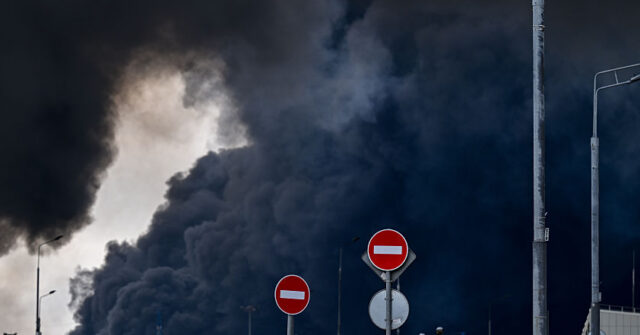
The refinery attack produced thick black smoke and intermittent flames from the facility’s distinctive red-and-white smokestacks. Videos circulating on social media showed vehicles covered in sooty black precipitation as debris from the assault rained down on the surrounding area.

Moscow Mayor Sergei Sobyanin stated the fire was largely contained, with crews working to extinguish remaining hotspots. However, the repeated strikes on Russia’s energy sector appear to be generating supply pressures, with Russian independent outlet Agentstvo reporting that one in four gas stations nationwide has imposed purchasing restrictions on drivers.

Ukrainian Foreign Minister Andrii Sybiha took to social media platform X to address confused Moscow residents. He pointed to Russia’s initial aggression as the root cause of the strikes now reaching deep into Russian territory, challenging Putin directly on when he plans to terminate the war.

The drone strike also caused collateral damage beyond the refinery itself. A residential building in the town of Zhukovsky sustained a direct hit, while debris from intercepted drones damaged structures elsewhere in the greater Moscow region, injuring 17 people including two children, according to regional Governor Andrei Vorobyov.

Thursday’s assault came mere hours after Zelenskyy announced he had conducted coordination talks with the presidents of the United States and France, securing additional pledges of support from the G7 summit. The Ukrainian president was scheduled to continue diplomatic efforts in Brussels with NATO and European Union leadership, including discussions on developing a continental ballistic missile defense system.

The strikes represent a continued embarrassment for Putin’s military, following a Ukrainian drone attack on his hometown of St. Petersburg earlier this month during a high-profile economic forum attended by foreign dignitaries.

Putin was in Kazan, approximately 700 kilometers east of Moscow, hosting leaders from the Association of Southeast Asian Nations as Russia seeks to strengthen economic and diplomatic relationships with the regional bloc during the ongoing conflict.

Zelenskyy emphasized Ukraine’s determination not to remain passive, stating his country will respond forcefully as long as Putin refuses to end the war. The Ukrainian president has accepted an unconditional ceasefire demanded by former President Trump, but Putin has declined, and United States-led peace initiatives have stalled.

Beyond diplomatic gains at the G7 summit, Ukraine has recently regained battlefield momentum against Russia’s numerically superior forces through advanced drone technology, according to Western officials and military analysts. Extended-range drone operations are disrupting Russian supply chains in occupied Ukrainian territories while simultaneously degrading Russia’s petroleum production capacity.

French President Emmanuel Macron characterized the G7 summit as crucial for Ukraine, citing commitments from supporters including the United States to continue assistance, though he provided no specific details. Under the Trump administration, American aid to Ukraine has decreased, leaving European nations as the primary sources of military and financial support.

Moscow authorities insisted that petroleum product supplies to the capital and gas station operations continue normally despite the refinery attack, though mounting evidence suggests fuel availability constraints in multiple Russian regions.

With information from Breitbart News

Share:
Newsroom
Newsroom

NewsFire.GR is a website created with the hope that the media will rediscover their true identity, which is none other than informing the public about the real stakes of our times. Journalism and political analysis must hold power accountable, not serve it.

The large-scale assault on Russian energy infrastructure disrupted operations at four Moscow airports and targeted the Moscow Oil Refinery on the southeastern outskirts of the capital, approximately 15 kilometers from the Kremlin. The facility, which produces over a third of the Moscow region’s fuel supply, represents one of Russia’s largest petroleum processing plants.

Ukrainian President Volodymyr Zelenskyy defended the strikes in stark terms, warning that if Ukraine is going to burn, your Moscow will burn too, as Breitbart News reports. The Ukrainian leader framed the attacks as necessary to force Russian President Vladimir Putin to negotiate an end to the conflict that began over four years ago.

Russia’s Defense Ministry claimed its air defenses intercepted 555 Ukrainian drones across multiple regions overnight, with nearly 200 shot down approaching Moscow alone. This represents roughly double the number of drones Russia launched at Ukrainian targets during the same period, according to Ukrainian air force statistics.

The refinery attack produced thick black smoke and intermittent flames from the facility’s distinctive red-and-white smokestacks. Videos circulating on social media showed vehicles covered in sooty black precipitation as debris from the assault rained down on the surrounding area.

Moscow Mayor Sergei Sobyanin stated the fire was largely contained, with crews working to extinguish remaining hotspots. However, the repeated strikes on Russia’s energy sector appear to be generating supply pressures, with Russian independent outlet Agentstvo reporting that one in four gas stations nationwide has imposed purchasing restrictions on drivers.

Ukrainian Foreign Minister Andrii Sybiha took to social media platform X to address confused Moscow residents. He pointed to Russia’s initial aggression as the root cause of the strikes now reaching deep into Russian territory, challenging Putin directly on when he plans to terminate the war.

The drone strike also caused collateral damage beyond the refinery itself. A residential building in the town of Zhukovsky sustained a direct hit, while debris from intercepted drones damaged structures elsewhere in the greater Moscow region, injuring 17 people including two children, according to regional Governor Andrei Vorobyov.

Thursday’s assault came mere hours after Zelenskyy announced he had conducted coordination talks with the presidents of the United States and France, securing additional pledges of support from the G7 summit. The Ukrainian president was scheduled to continue diplomatic efforts in Brussels with NATO and European Union leadership, including discussions on developing a continental ballistic missile defense system.

The strikes represent a continued embarrassment for Putin’s military, following a Ukrainian drone attack on his hometown of St. Petersburg earlier this month during a high-profile economic forum attended by foreign dignitaries.

Putin was in Kazan, approximately 700 kilometers east of Moscow, hosting leaders from the Association of Southeast Asian Nations as Russia seeks to strengthen economic and diplomatic relationships with the regional bloc during the ongoing conflict.

Zelenskyy emphasized Ukraine’s determination not to remain passive, stating his country will respond forcefully as long as Putin refuses to end the war. The Ukrainian president has accepted an unconditional ceasefire demanded by former President Trump, but Putin has declined, and United States-led peace initiatives have stalled.

Beyond diplomatic gains at the G7 summit, Ukraine has recently regained battlefield momentum against Russia’s numerically superior forces through advanced drone technology, according to Western officials and military analysts. Extended-range drone operations are disrupting Russian supply chains in occupied Ukrainian territories while simultaneously degrading Russia’s petroleum production capacity.

French President Emmanuel Macron characterized the G7 summit as crucial for Ukraine, citing commitments from supporters including the United States to continue assistance, though he provided no specific details. Under the Trump administration, American aid to Ukraine has decreased, leaving European nations as the primary sources of military and financial support.

Moscow authorities insisted that petroleum product supplies to the capital and gas station operations continue normally despite the refinery attack, though mounting evidence suggests fuel availability constraints in multiple Russian regions.

With information from Breitbart News

